
Bangladesh’s Fallen Awami League Reignited a Legacy of Terror

Bodiuzzaman Biswas
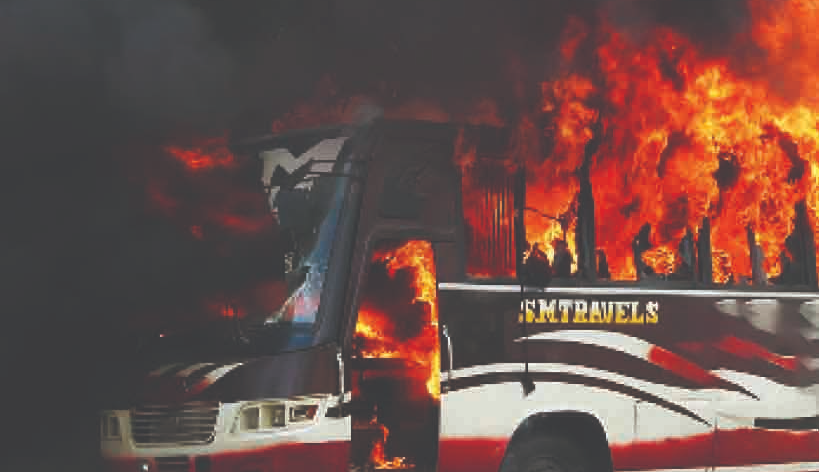
In the tense days leading toward the declaration of the verdict date against ousted Prime Minister Sheikh Hasina—accused of genocide and crimes against humanity—Bangladesh has again found itself engulfed in a familiar and frightening spectacle: the calculated choreography of fire, fear, and clandestine violence. Wherever the post-revolutionary nation attempts to step forward, the shadows of a defeated political dynasty attempt to pull it back through the only political grammar they truly mastered—arson, sabotage, and manufactured anarchy.
Over several days, Dhaka, Mymensingh, and other regions have witnessed a sudden resurgence of coordinated attacks: buses torched in the dead of night, train engines set ablaze, and crude explosives hurled into public spaces. Indeed, Bangladeshis are re-experiencing a pattern they have seen for more than a decade—small fires ignited for the purpose of fueling large-scale political narratives.
Law enforcement officials, intelligence operatives, and independent analysts increasingly converge on a single conclusion: these attacks bear the unmistakable imprint of the banned Awami League and its loyalist terror networks, the same forces that for years constructed a false narrative accusing BNP and Jamaat-e-Islami of identical crimes while quietly orchestrating the violence themselves.
What once was framed as the “fire-terror politics” of opposition parties has now, in the aftermath of the July Revolution, been unmasked as the political weapon of the Awami League itself—a tool they wielded shamelessly to suppress dissent, discredit rivals, and fabricate consent. Today, with its leadership dispersed, its chairperson facing trial for crimes against humanity, and its political hegemony shattered, the Awami League’s desperation has returned to its original signature: terror by fire.
A New Wave of Arson, an Old Script from a Fallen Regime
The fresh sequence of attacks began just as the International Crimes Tribunal prepared to announce the date for a landmark verdict against Sheikh Hasina. Within hours of the tribunal’s internal scheduling discussion, fire erupted across both urban and semi-urban regions—an eerie replay of the years when arson became a normal instrument of Awami League rule.
Last month, several buses were set ablaze in Dhaka, and a sleeping driver, Julhas Mia, was burned alive inside a parked vehicle in Mymensingh—a death chillingly reminiscent of earlier years when innocent civilians were quietly sacrificed to sustain political narratives.
A commuter train engine was also set afire in the same district. Across the capital, crude explosives—cocktails and hand grenades—were thrown at random, often into narrow lanes or near party offices, mimicking the techniques long deployed by politically connected terror wings.
Senior police officers, intelligence officials, and even members of the interim government point to the same perpetrators: cadres of the banned Awami League and their paid enforcers, many of whom have been caught in the act, interrogated, and even confessed.
In the words of one investigative officer, “The signature of these attacks is unmistakable. Only one group in this country has used arson as a political doctrine: the Awami League.”
The Awami League’s Political Doctrine of Fire
To understand the present, one must revisit the last fifteen years—years in which Whichever narrative served the ruling Awami League was projected upon the opposition, while the truth remained hidden behind state-controlled media, compromised police investigations, and an absolute monopoly on public discourse.
From 2013 to 2016, Bangladesh witnessed its darkest era of political violence cloaked in propaganda. Every incendiary attack, every burned bus, every explosion was immediately framed as an act of BNP-Jamaat sabotage. Ministers held press conferences. The prime minister blamed the opposition. Police arrested hundreds, mostly innocent people.
Yet global observers, diplomats, and independent local journalists often reported that the incidents looked staged, the investigations suspiciously shallow, and the prosecution too swift to be credible. Today, with the Awami League stripped of its protective institutions, the truth can finally breathe.
The hard reality
The Awami League perfected the craft of weaponizing arson:
• It used fire to manufacture justification for crackdowns.
• It used fire to delegitimize political opposition.
• It used fire to control public fear and impose emergency measures.
• It used fire to write a fiction in which all resistance was terrorism.
It is no coincidence that nearly all fire incidents occurred in areas where state surveillance was most intense, nor that perpetrators were rarely brought to trial, nor that the party always benefitted from the aftermath. What the world is now seeing—with the resurgence of nearly identical attacks—is not a new phenomenon but the reappearance of an old political instrument now wielded by a desperate, cornered group fighting for survival before a historic tribunal verdict.
Dhaka’s Night Fires: A Case Study in Manufactured Chaos
The banned Awami League has already triggered 17 cocktail explosions in the capital in just two days last month. Nine vehicles have been torched. More than 100 suspects have been arrested across 17 cases. These are not random acts. These are deliberate attempts to drag Bangladesh into an atmosphere of fear and instability precisely when the judicial process is reaching its most consequential point.
Law enforcement sources explain that Awami League leaders and supporters, unable to openly mobilize, are resorting to decentralized sabotage—small but high-impact attacks designed to:
1. Disrupt public confidence.
2. Pressure the tribunal by creating a perception of national instability.
3. Delegitimize the interim government.
4. Derail the upcoming election process.
5. Invoke memories of past unrest when Hasina portrayed herself as a “defender of stability.”
Yet these tactics are failing.
This time, the public knows who the arsonists are. This time, the fireproof veil of propaganda has burnt away.
Mymensingh: A District Under Siege
Two major incidents in Mymensingh have shaken the nation:
1. A commuter train engine torched
The Balaka commuter train’s engine burst into flames around 10:20 AM. Passengers were evacuated in panic as authorities halted services on both the Mymensingh-Netrokona and Bhairab lines. Again, the hallmarks of a signature arson attack were present: a quick flame trigger, masked perpetrators, and a calculated
choice of timing.
2. A late-night bus fire that killed an innocent driver
CCTV footage revealed three masked men setting fire to a bus within three seconds, leaving the sleeping driver, Julhas Mia, to burn alive—a method eerily consistent with earlier attacks historically blamed on BNP-Jamaat.
The OC confirmed that culprits escaped with the efficiency of trained operatives, not of ordinary criminals. The message from the attack was unmistakable: create terror, create chaos, create headlines. Exactly as Sheikh Hasina’s operatives did during the previous era.
The Awami League’s Old Strategy in a New Mask
Security analysts recall that the 2014 and 2016 election cycles were marred by similar waves of arson. At that time, the Awami League skillfully weaponized public emotion, repeatedly claiming that BNP and Jamaat were burning buses to “destabilize democracy.” But now that the Awami League is banned and stripped of state protection, and yet the same pattern of attacks resurfaces, the illusion collapses.
Everywhere, people are asking:
“If BNP and Jamaat used to be responsible, who is responsible now?” The answer is glaringly obvious. The same party that once benefited from the accusations is now exposed by the pattern of violence it perfected. Even pro-BNP analysts argue openly that the Awami League’s current fire-terror campaign is nothing more than a replay of the tactics it used during its 15-year authoritarian rule—this time without the shield of state institutions.
Intelligence Report: Major Sabotage Plans in Motion
A recent intelligence brief reveals that the Awami League’s fragmented networks are planning large-scale attacks, using small incidents as precursors to psychological warfare.
The goal is to:
• generate panic,
• create the impression of an ungovernable nation,
• stir international concern,
• and cast doubt on the tribunal’s ability to proceed and the verdict of Sheikh Hasina’s death penalty.
What alarms officials most is the lack of advance intelligence. This suggests that the planners—mostly former ruling party operatives—are using compartmentalized cells, burner phones, and cash-based logistics. These tactics resemble the very militant-style networks the Awami League once accused the opposition of running.
A Party Trapped in Its Own Rhetoric
The stunning irony, which social media users are highlighting ruthlessly, is an old clip of Sheikh Hasina from 2023.
Standing at a rally, she declared:
“If anyone sets fire to a bus, burn the hand that lit the fire.” Today, with Awami League cadres caught on CCTV burning buses, this statement has turned into a weapon of public ridicule. The same woman who advocated public lynching of “arsonists” now stands accused of ordering systematic arson to weaken democratic processes. The same party that claimed moral superiority is now exposed as the architect of terror.
Tribunal, Tensions, and the Persistence of Fear
The International Crimes Tribunal prosecutor Gazi Monwar Hussain Tamim stated that public frustration is rising sharply, noting that ordinary citizens are outraged at the use of fire-terror tactics to influence the post-judicial process. After announcing the verdict, Awami League are planning to destabilize Bangladesh.
Meanwhile, the DMP Commissioner assures that law and order remains under control, dismissing social media rumors of impending chaos on the Awami League’s so-called “lockdown day." The Home Affairs Advisor has tightened security measures, increased patrolling, barred roadside fuel sales, and directed police to report suspicious individuals immediately.
The Verdict Approaches: A Party Confronts Its Past
As Bangladesh declares a historic judgment against Sheikh Hasina for genocide and crimes against humanity, the country is witnessing the last, frantic struggle of a fallen fascist machine trying to stay relevant through the only politics it ever mastered: fire, fear, and chaos. For years, Awami League strategists scripted a story in which the opposition was the enemy of stability and the ruling party was the guardian of peace.
Now, as flames burst across the capital without BNP or Jamaat anywhere near power, the truth stands naked. The Awami League is the fire-terror party. It always was. Only now has the nation finally been able to see it clearly. The crimes of the past and the violence of the present share a single origin: Sheikh Hasina’s deliberate strategy to weaponize arson for political gain. As the tribunal issues its verdict, Bangladesh stands at a crossroads—between the possibility of justice and the dying embers of a fallen fascism desperate to reignite itself. But the pattern is unmistakable: fires are no longer a political language anyone believes, and the arsonists are no longer cloaked in propaganda.
The fallen Awami League has returned to its old tactics, but the nation it once ruled by fear now sees through the smoke. The age of fire-terror is ending, and its architects are facing judgment.