
Bangladesh After the Ballot: The Next Five Years Will Decide the Republic

Mohammad Waliuddin Tanvir
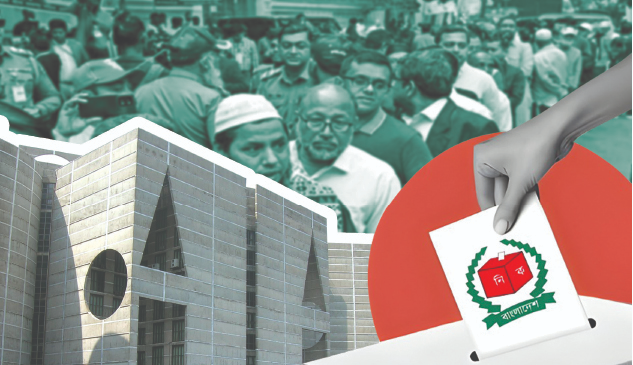
Bangladesh’s post-2026 transition will be judged not merely by the scale of electoral victory, but by whether power is institutionalised, opposition rights are protected, constitutional reforms are implemented transparently, and restraint, accountability, and pluralism replace historical cycles of dominance
The 2026 election was not merely a change of government; it was a reset of political time. Bangladesh has entered a rare phase in its history: a post-uprising democratic transition combined with a landslide parliamentary mandate and a public vote for constitutional reform. Moments like this come perhaps once in a generation. They also come with a paradox: the same forces that create hope can easily create disappointment if expectations outrun delivery.
The next five years will determine whether Bangladesh becomes a stable post-transition democracy—or slips into another cycle of dominance, disillusionment and confrontation. The 2026 general election in Bangladesh marked the first national vote after the 2024 political transition and resulted in a decisive victory for the BNP-led alliance. The alliance secured a parliamentary majority while receiving just under half of the total votes cast, highlighting the impact of the first-past-the-post electoral system. The Jamaat-led alliance emerged as the main opposition, winning 77 seats and around 38–44 percent of the vote depending on alliance calculations. For the first time in decades, the Awami League did not participate in the election, reshaping the country’s traditional two-party landscape. The results signal the beginning of a new political era defined by a dominant government and a strong, nationally supported opposition.
The burden of a landslide
Landslide victories feel powerful, but they are politically dangerous. When voters deliver overwhelming power to one party after a period of upheaval, they are rarely giving unconditional loyalty. More often, they are issuing a deadline. The BNP’s super-majority is best understood as a mandate to fix the system, not simply to run it. Voters did not just choose a party; they rejected a political era. The uprising of 2024 created a national demand for institutional repair—an election commission that inspires trust, courts that feel independent, and a state that does not appear partisan.
This means the governing party faces a challenge more complex than economic management or routine policymaking. It must prove that power can be used to reduce the abuse of power. That is a test many post-authoritarian governments struggle to pass. The public expectation is simple but profound: never again should the political system feel closed.
From two-party rivalry to a new political map
For three decades, Bangladesh politics revolved around a binary contest. That era is over—at least for now. The absence of the Awami League from the election has produced something Bangladesh has not experienced in decades: a dominant governing party alongside a reconfigured opposition space. In that space, Jamaat’s strong parliamentary presence is politically significant. It signals that ideological diversity is returning to parliament after years of constricted competition.
This shift will reshape political debate. Instead of personality-driven rivalry between two dynastic parties, the next parliament could see a more ideological contest over governance, reform, and national identity. That could deepen democratic debate—if managed carefully. But it also carries risks. When one party governs with a commanding majority and the traditional rival is weakened, the temptation to centralise power quietly returns. Bangladesh’s political history offers repeated warnings about this cycle.
The referendum promise—and the reform test
The constitutional referendum changes the stakes of this election. The new parliament is not just a legislature; it is effectively a reform assembly. Term limits, electoral safeguards, judicial strengthening—these are not ordinary policy pledges. They are structural promises. They aim to reshape the rules of the political game itself.
History shows that post-transition governments succeed or fail largely on this question: do they institutionalise reform while they still have public trust? Or do reforms slow down once power feels secure?
The first two years of this parliament will be decisive. If meaningful reforms are enacted quickly and transparently, Bangladesh could enter a period of democratic consolidation similar to the early 1990s. If reforms stall, public frustration may rise just as quickly as hope did. Revolutions create expectations faster than governments can satisfy them.
Managing the expectations economy
The emotional energy behind this election is enormous. Citizens expect accountability, economic recovery, political normalisation and institutional reform simultaneously. No government can deliver all of this at once.
This creates what political scientists call an “expectations gap”—the distance between public hopes and the speed of real change. Managing this gap may be the single most important political task of the next government. Economic stabilisation will be the immediate pressure point. Inflation, employment, and investment confidence will determine whether citizens feel the transition improving their daily lives. Political legitimacy in post-transition states often depends less on ideology and more on whether life becomes visibly more stable.
The international dimension
The global reaction to the election has been cautiously optimistic. That goodwill is an opportunity. Bangladesh now has a window to rebuild investor confidence, reset diplomatic relationships and re-position itself as a stable democracy in South Asia. But international confidence is fragile. It depends on visible institutional progress and political stability. The next few years will shape how Bangladesh is perceived globally for the next decade.
The long shadow of history
Bangladesh’s political story has often moved in cycles: hope, polarisation, dominance, crisis—and then renewal. The 2026 election marks another moment of renewal. Whether it becomes a turning point depends on what follows.
The true test of this new era will not be the scale of victory, but the restraint shown in using it. Durable democracies are built when governments voluntarily limit their own power. Five years from now, Bangladesh will either be seen as a successful post-transition democracy—or as a country that missed a rare opportunity. The voters have opened the door. The next chapter now belongs to those in power.
The Awami League Question: Bangladesh’s Next Democratic Test
Over the next five years, one of the most important questions in Bangladesh’s politics will be how the ruling BNP and the main opposition, Jamaat, deal with the future of the Awami League. Although the Awami League currently appears leaderless and absent from national electoral politics, it would be unrealistic to assume that this represents permanent political inactivity. It is likely that, through lesser-known new leadership and a renewed political identity emerging before the July uprising, the party will attempt to reorganise itself and reposition within the changing political landscape. Reports that some local BNP leaders are informally absorbing Awami League activists already continues a gradual process of reintegration. Whether this trend eventually turns into formal political rehabilitation will be a major test of the next political cycle.
At the same time, the public will closely watch how the BNP advances the judicial process concerning Awami League leaders and activists. Although Mr Tarique Rahman has spoken about moving the process of justice forward, this will not be an easy task for him in practice. How the BNP manages this process, and how Jamaat responds as the main opposition, will reveal the strength of their commitment to democratic pluralism, reconciliation, and long-term political stability in Bangladesh.
In essence, the next five years will therefore test not only the governing party’s ability to deliver reform, but the entire political system’s capacity for maturity. How power is exercised, how opposition is practised, and how former rivals are treated will shape the character of Bangladesh’s new political era. Democracies are not defined by landslides alone; they are defined by how winners use victory and how the political arena remains open to future competition. Bangladesh now stands at a crossroads where restraint, inclusion and institutional reform could transform a moment of transition into a lasting democratic legacy. The ballot has spoken, but the real verdict will be written in the years ahead.