
Convict in Exile: Can India Afford to Shelter Sheikh Hasina Anymore?

Mohammad Waliuddin Tanvir
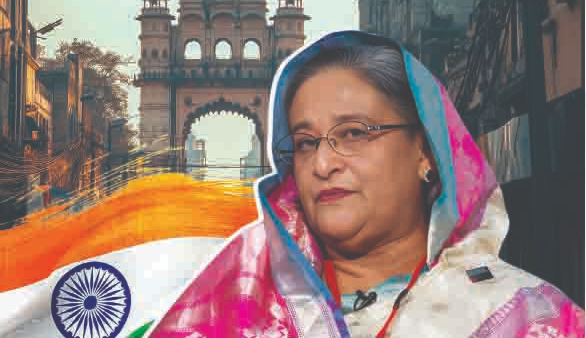
Sheikh Hasina once ruled Bangladesh with absolute control, but today she lives in guarded obscurity somewhere inside India—no longer a sitting prime minister, but a convicted fugitive facing charges of genocide, murder, and crimes against humanity. Her dramatic fall, from the peak of political dominance to a life of uncertain exile, has created one of the thorniest foreign policy dilemmas New Delhi has faced in decades.
On 5 August 2024, as student-led protests exploded nationwide, Hasina fled Dhaka by helicopter and sought refuge in India. The uprising, which began with demands for civil service reform, quickly evolved into a mass revolt against authoritarianism. The regime responded with force—live ammunition, mass arrests, extrajudicial killings—and by the time she escaped, hundreds were dead and thousands injured. The political vacuum that followed ushered in a transitional government led by Nobel laureate Dr. Muhammad Yunus, tasked with rebuilding institutions and pursuing accountability. One of its earliest decisions was to file formal charges against Hasina and her top officials through Bangladesh’s International Crimes Tribunal. That process culminated in the 2025 death sentence announced in her absence. Her exile in India has now become the centre of a complex diplomatic storm—not only for Delhi, but for the future of South Asia.
A Strategic Ally Turned Diplomatic Burden
For more than 15 years, Hasina was India’s closest regional partner. She cracked down on extremist groups, facilitated counterinsurgency operations, kept China at arm’s length in the Bay of Bengal, and aligned Bangladesh’s policies with India’s strategic interests. Indian diplomats routinely described her as “the best bet” for regional stability. But beneath that partnership grew a regime marked by democratic decline—election manipulation, the persecution of opposition parties, censorship, and abuses of state power. India, prioritising security over democratic principles, continued supporting her, even lobbying the United States to soften pressure during Bangladesh’s controversial 2024 election. Now that support has backfired. A leader once considered indispensable is now a legal liability and a political burden.
India’s Three Uncomfortable Options
New Delhi faces a trilemma with no painless exit.
1. Extradite Hasina to Bangladesh
Dhaka formally requested her extradition in December 2024. Sending her back would boost India’s democratic credibility and align Delhi with Bangladesh’s transitional justice process. It would also help restore trust with the new Bangladeshi leadership.
But the risks are enormous. Extraditing Hasina—who now faces a death sentence—could provoke political backlash, destabilise Bangladesh further, and anger loyalists within the Awami League. India’s 2013 extradition treaty allows refusal in cases of potential political persecution, giving Delhi room to decline.
2. Grant Her Political Asylum
India has a long tradition of sheltering political figures, and Hasina herself lived in India after the 1975 assassination of her father. However, presenting her as a persecuted refugee ignores the scale of allegations against her. Granting asylum to a leader accused of state-sponsored violence could inflame anti-India sentiment in Bangladesh, where many already view India as complicit in her authoritarian excesses. Such a move would also undermine India’s claim to moral leadership in the region.
3. Relocate Her to a Third Country
Quietly facilitating Hasina’s transfer to a neutral country—Qatar has been mentioned in diplomatic circles—may be India’s safest option. It allows Delhi to avoid choosing outright between loyalty and law while signalling goodwill to Bangladesh’s interim government. But it also raises questions about India’s responsibility and its attempt to escape accountability for years of enabling her rule.
What Kind of Power Does India Want to Be?
At the heart of this dilemma lies an identity crisis. India has long presented itself as a democratic counterweight to China’s influence in the region. Yet its continued protection of a former ally accused of severe human rights abuses exposes a contradiction. India’s official statement on Sheikh Hasina’s verdict is notably cautious, diplomatic, and intentionally vague—crafted to acknowledge the tribunal’s decision without committing to any specific course of action regarding Hasina’s status in India. By merely “noting” the verdict, New Delhi avoids endorsing or criticising the ruling, preserving room for maneuver at a moment when every word carries geopolitical weight. The emphasis on “peace, democracy, inclusion and stability” in Bangladesh signals India’s desire to align itself with the aspirations of the Bangladeshi public rather than with any individual political figure—an implicit shift from its long-standing, personalised ties with Hasina. At the same time, the promise to “engage constructively with all stakeholders” suggests India is preparing to work with Bangladesh’s new political realities while keeping its options open on sensitive issues like extradition. Overall, this is a carefully worded attempt to project neutrality, protect India’s strategic interests, and quietly distance itself from a leader who has become a diplomatic liability.
Hasina’s Narrow Path
For Sheikh Hasina, the horizon has narrowed to three deeply fraught choices, each more perilous than the last. Returning to Bangladesh would mean surrendering to a judicial process that has already sentenced her to death—a move that might restore a measure of political dignity but at the cost of her freedom, and possibly her life. Remaining in India offers physical safety but erodes her political relevance day by day; exile is not a neutral space, it is a slow political decay. Cut off from her supporters and stripped of her ability to shape events on the ground, Hasina is watching her influence shrink from afar. Her third option—appealing to the international community—may bring diplomatic noise and sympathetic headlines, but the world moves cautiously, especially when human rights rhetoric collides with geopolitical calculations. International bodies can express concern, but they cannot resurrect her authority or rescue her party from implosion.
And the vacuum her absence has created is devastating for the Awami League. Once the most formidable political machine in Bangladesh, the party is now leaderless and directionless. Its senior members have been jailed, have fled, or are hiding in safe houses in fear of arrest. The organisational structure that once could mobilise tens of thousands with a single directive has collapsed so completely that even social media calls for protests go unanswered. The silence from its traditional support base is not mere hesitation—it is a verdict. A party that once operated with military-like discipline can no longer rally even its loyal foot soldiers.
Hasina’s personal crisis has thus metastasised into an existential crisis for her party. The Awami League is no longer simply weakened; it is adrift, fractured, and unsure of what it stands for without the figure at its centre. Her exile, far from being a pause, has accelerated the party’s descent into political irrelevance.
Can India afford to shelter Sheikh Hasina any longer?
This is no longer just a matter of legal procedure or diplomatic courtesy—it is a profound test of what India stands for in a rapidly shifting South Asian landscape. Shelter¬ing Hasina may once have aligned with India’s strategic interests, but today it carries a heavy political cost. Her presence on Indian soil risks fuelling anti-India sentiment in Bangladesh, undermining Delhi’s credibility as a defender of democratic principles, and tying India to a leader now indelibly associated with authoritarian excess. On the other hand, sending her back—where a death sentence awaits—would force India to confront uncomfortable questions about human rights, political persecution, and its responsibility toward a former ally it championed for over a decade.
The outcome will not only shape the trajectory of Bangladesh’s fragile political transition but will redefine India’s image in the region: Is it a principled democratic power, or a regional hegemon guided solely by political convenience? How India navigates this moment will send a message far beyond Dhaka. It will reach Colombo, Kathmandu, Male, and Islamabad—capitals watching closely to see whether India’s commitments to justice and stability are genuine or selective. What happens next will echo through the region, influencing alliances, perceptions, and the very architecture of South Asian politics for years to come.
A Region Waiting for an Answer
Sheikh Hasina’s exile has become more than a personal reckoning—it is now a test of South Asia’s political character. India must decide whether to prioritise democratic principles or strategic convenience, a choice that will shape its credibility far beyond its borders. Bangladesh’s fragile transition depends on whether justice can proceed without external interference, while the Awami League’s future hinges on whether it can survive without the leader who once defined it.
Whatever India chooses—extradition, asylum, or quiet relocation—will send a message across the region about the kind of power it aspires to be. Hasina’s fate now sits at the intersection of principle and pragmatism, and Delhi’s next move will echo through the political destinies of both nations. In the end, this decision will not only resolve a diplomatic dilemma; it will reveal the moral and strategic contours of South Asia for years to come.