
From Silence to Reckoning: Memory, Violence, and the Unfinished Story of May 5 in Bangladesh

Mohammad Waliuddin Tanvir
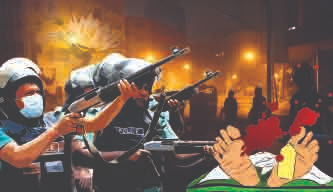
AFTER PART-1
In the first part of this article, I concluded by stating that May 5 is not just a memory—it is a warning. It is a cautionary tale etched in blood and silence, a grim reminder of what happens when state power is wielded without restraint and citizens’ rights are trampled under the cover of darkness. The massacre at Shapla Chattar was not merely the violent dispersal of a crowd—it was a direct assault on the democratic right to dissent, to assemble, and to demand accountability. It was an event that revealed the terrifying fragility of civil liberties when confronted by the brute force of a state determined to silence opposition.
On that night, the heart of Dhaka became a battleground—not between armed enemies, but between an unarmed mass of protesters and the state apparatus meant to protect them. The streets, once filled with chants and Qur’anic recitations, were left littered with shattered bodies, shattered trust, and unanswered questions. Yet in the aftermath, a collective amnesia seemed to take hold. Neither the Awami League, the ruling party at the time and orchestrator of the crackdown, nor Hefazat-e-Islam, the group at the center of the protest, appeared willing or able to confront the moral and political weight of what transpired. Both sides moved forward—one in denial, the other in silence—leaving a nation confused, conflicted, and dangerously uninformed about the scale and meaning of the violence that occurred.
In this second part of the article, the aim is to unpack the complex and layered implications of the events surrounding the May 5 massacre at Shapla Chattar. Far from being an isolated or aberrational incident, that night represents a turning point in Bangladesh’s political trajectory—one that exposed the deep fractures in the country’s democratic institutions, its political culture, and its social fabric. This examination draws not only on historical facts and political developments, but also on the raw, often heartbreaking testimonies of those who were present, whose voices have been systematically silenced or ignored. Through a close reading of these firsthand accounts, we encounter the human cost of political violence—the fear, the confusion, the grief, and the long shadows cast over communities still struggling to process what happened. These testimonies help bring into focus what is often obscured in official narratives: the lived experience of state repression, the trauma of surviving a massacre, and the alienation felt by those whose suffering was never acknowledged.
The analysis also explores the political dynamics at play—how the government of the day used state power not for the preservation of order or democracy, but for the consolidation of control. The state’s violent response to the protests was not simply about dispersing a crowd; it was about sending a message, that dissent, particularly religiously motivated dissent, would not be tolerated unless it could be co-opted or neutralized. What followed in the years after was a pattern of strategic appeasement, surveillance, and divide-and-rule tactics, aimed at weakening potential threats while maintaining a facade of pluralism. This period also brought to the surface long-simmering socio-religious tensions. The Hefazat movement, composed largely of madrasa students and traditional Islamic scholars, represented a constituency that felt both marginalized and misrepresented in national discourse. Their rise—and the state’s reaction to it—revealed a deep discomfort within the ruling elite toward religious populism that it could not fully control. At the same time, Hefazat itself lacked a coherent political strategy and often failed to grasp the consequences of its own mobilizations, making it vulnerable to manipulation and betrayal.
Perhaps most troublingly, these events laid bare the failure of institutional checks and balances. The judiciary remained silent. Civil society, with a few exceptions, looked away. Much of the media chose to echo the official narrative or avoid the topic altogether. This systemic complicity created an environment in which state violence could be enacted without accountability, and in which memory itself could be suppressed or rewritten. Since those fateful days, Bangladesh’s trajectory has only grown more troubling. The hallmarks of authoritarianism—centralized power, weakened opposition, media censorship, and state surveillance—have deepened. At the same time, religious communities have been alternately courted and scapegoated, instrumentalized in ways that further erode trust in democratic norms. National tragedies, rather than provoking national introspection, have increasingly been used to distract from deeper structural decay—from corruption, from institutional erosion, from the gradual normalization of repression. To revisit May 5 is not merely to revisit a massacre. It is to hold a mirror to a nation and ask-what have we become since that night? And more urgently, what happens when a people forget what was done in their name, and to their own?
Emotional and Existential Reverberations
One of the victims, a man we will refer to as Faiz (a pseudonym used here to protect his identity), shared his harrowing experience with the author under the strict condition of anonymity. Still gripped by a deep and enduring trauma, Faiz lives in fear that any revelation of his identity might expose him to reprisal or renewed danger. His voice trembled as he spoke—fragmented, hesitant, as if the memory itself was too volatile to fully articulate. And yet, within the brokenness of his words lay a profound testimony—not just of what he endured that night, but of how the violence continues to live within him. He said: "It was a shock. Something sudden yet deep, that became permanent and still... I would discover a new alleyway for escape."
In this haunting reflection, Faiz offers more than a description of trauma—he gives voice to a kind of spiritual and existential fracture, a moment in which the violence was not simply physical but metaphysical. What was taken from him was not only safety or dignity, but the continuity of ordinary life itself. He now exists in a world where memory is dangerous, where truth must be whispered, and where survival depends as much on silence as it once did on prayer.
The Architecture of Forgetting
The aftermath of May 5 was not marked by public mourning or collective grief. Instead, it was greeted with silence—state-imposed and self-inflicted. This was not mere forgetfulness but what scholars of authoritarianism term "strategic amnesia": the calculated refusal to acknowledge state violence. In Bangladesh’s context, this amnesia was enforced through a coordinated campaign involving media censorship, judicial inertia, and bureaucratic deflection. The ruling Awami League swiftly took control of the narrative, employing a mixture of denial and obfuscation. Reports of casualties were either dismissed or underplayed, and calls for independent inquiries went unheeded. The state’s messaging apparatus engaged in a two-fold strategy: portray the protesters as extremists threatening national order, and delegitimize any attempt to memorialize the dead. But amnesia is never neutral. It privileges the powerful, disenfranchises the victims, and renders suffering invisible. In such an environment, memory becomes a form of resistance, and remembering the names, faces, and stories of the slain becomes a political act.
The Limits of Protest Politics
Hefazat-e-Islam’s role in the events of May 5 is complex. Initially a loosely organized movement of conservative Islamic scholars and madrassa teachers, it rose rapidly in national prominence. However, its surge lacked institutional depth. When the massacre occurred, Hefazat’s ability to respond with coordinated documentation, legal mobilization, or international advocacy was negligible. One would assume that a group whose members were targeted so violently would become the custodian of their memory. Yet, more than a decade later, not even a verified list of the deceased exists. This absence is not only bureaucratic—it is a moral indictment. The dead have no names, no gravesites formally recognized, no anniversaries honored with detail.
The reasons for this are manifold. First, Hefazat suffers from internal fragmentation. Lacking centralized leadership, consistent funding, and modern organizational infrastructure, it failed to channel its outrage into sustained political action. Second, the group’s conservative outlook, while resonant in certain rural constituencies, left it ill-equipped to form alliances with civil society, human rights groups, or international watchdogs. Lastly, and perhaps most tragically, the movement may have been co-opted or placated in the years following the massacre, diluting its earlier confrontational stance. In failing to preserve the memory of their own, Hefazat not only betrayed the trust of its supporters but also inadvertently contributed to the erasure orchestrated by the state.
Memory as a Political Battleground
Why does remembering matter? In political theory, the act of remembering is not a passive recollection—it is a form of justice. Naming victims, documenting their stories, and investigating the conditions of their deaths disrupts the official version of history and forces a society to reckon with its past. The contrast is jarring. When memory serves the national narrative, it is embraced; when it questions power, it is buried. This asymmetry not only distorts history but hinders democratic development. A society that remembers selectively is one that heals incompletely. The Intersections of Class, Religion, and Voice: One of the less discussed aspects of May 5 is how it revealed deep class and cultural fissures in Bangladeshi society. The protesters were overwhelmingly poor, rural, and religious—drawn from madrassa backgrounds and marginalized communities. They did not have access to the cosmopolitan platforms that amplify elite voices. Unlike the Shahbagh movement, which was urban, digitally savvy, and embedded in the media ecosystem, Hefazat’s base was largely voiceless.
This asymmetry in representation meant that when violence was unleashed on Shapla Square, there were few journalists to chronicle it, few lawyers to demand justice, and even fewer public intellectuals willing to stand in solidarity. The victims were not just killed—they were silenced before and after death.
In Bangladesh’s polarized political discourse, the binary of "progressive versus fundamentalist" is routinely weaponized to justify repression. But such dichotomies obscure the lived realities of ordinary people, reducing them to caricatures. Hefazat's members were many things—conservative, religious, rural—but they were also citizens with the right to assemble, speak, and be heard. That right was brutally revoked.
Media, Manipulation, and Manufactured Consent
The role of media in the post-May 5 period warrants scrutiny. While some independent outlets attempted to raise questions, the dominant media narrative was either complicit or cowardly. Stories of mass graves, disappearances, and night-time raids were buried under sanitized headlines. The massacre was reframed as a necessary operation to maintain law and order. This manipulation of perception is emblematic of Bangladesh’s broader media environment, where corporate interests, government pressure, and self-censorship converge to suppress dissent. When journalism becomes a tool of the state, truth becomes the casualty. In the months following the massacre, international coverage was minimal. This was partly due to the complexity of Bangladesh’s internal politics, but also due to deliberate efforts by the state to control information. Foreign journalists were restricted, local reporters intimidated, and human rights organizations denied access.
The Broader Ecosystem of Impunity
May 5 did not occur in a vacuum. It was part of a continuum of state violence and impunity. From the 2009 BDR Mutiny to the 2012 Tazreen fire, and the 2013 Savar building collapse, Bangladesh has witnessed a series of crises where accountability was either delayed or denied. What unites these events is a pattern- initial outrage, followed by narrative control, token arrests, and eventual forgetting. The judicial system—deeply politicized—fails to deliver justice in cases that challenge state power or economic interests. As a result, impunity becomes normalized. In such a context, May 5 is both a symptom and a symbol. It illustrates how a state can brutalize its citizens and walk away unscathed, aided by a media that forgets, an opposition that flounders, and a public that feels powerless.
The Danger of Erasure and the Possibility of Remembrance
When the names of the dead are not known, they cannot be mourned. And when they are not mourned, the violence that claimed them is never fully condemned. This is the true danger of erasure—it allows the cycle of repression to continue unchecked. Remembrance, in this sense, is a radical act. It reclaims agency for the victims and demands accountability from the perpetrators. It insists that justice is not only a matter for the courts but also for the conscience of a nation. To move forward, Bangladesh must commit to a politics of memory that is inclusive, courageous, and justice-oriented. This involves supporting initiatives for truth-telling, creating archives of testimonies, enabling independent investigations, and building memorial spaces that honor the victims of political violence—whether from 1971 or 2013.
What Civil Society Can—and Must—Do
Given the failures of both the state and Hefazat, the burden now falls on civil society, human rights organizations, academics, and the diaspora. The tools of remembrance are within reach: oral histories, digital platforms, community memorials, and international advocacy. What is lacking is coordination and will. Universities can play a crucial role by initiating memory studies projects focused on underreported massacres. Journalists can return to the story with investigative rigor. Filmmakers, poets, and artists can give form to grief and resistance. And NGOs can demand the release of official documents, push for reparations, and assist families of the disappeared. The challenge is not just to remember May 5, but to ensure it becomes a turning point—a moment when silence gave way to speech, and forgetting yielded to justice.
The Fragile Line Between Order and Oppression
What makes the May 5 crackdown uniquely disturbing is not just its brutality, but its normalization. It was presented as a “clean-up operation”, and portrayed as a legitimate act of governance. In doing so, the line between order and oppression became dangerously blurred. Once a state normalizes such excessive force against its own citizens, especially under the veil of darkness, it sets a precedent where any group can be crushed, any protest discredited, and any tragedy explained away.
The events also reflect a deeper crisis of the political imagination in Bangladesh. Instead of addressing dissent with dialogue, the state responded with guns. Instead of seeing religious protest as part of the broader democratic mosaic, it viewed it as a threat to be neutralized. And instead of reckoning with the grievances that drove thousands to the streets, it responded with contempt, framing the entire mobilization as retrograde or foreign-inspired.
In reality, the tragedy of May 5 was not just about Hefazat or the Awami League. It was about how a democracy treats its own citizens when they step out of line. It was about the ethical boundaries of state power, and whether those boundaries still exist when political convenience is at stake.
Memory, Justice, and the Struggle Ahead
Today, more than a decade later, May 5 exists in an uneasy place in the national memory. For some, it is an unspoken scar; for others, a point of political opportunism. But for many—particularly those who lost sons, brothers, or friends—it remains an open wound.
Justice, in any meaningful sense, remains elusive. There have been no independent commissions of inquiry, no public hearings, no memorials, and certainly no accountability for the violence. The victims’ families continue to live in silence, surrounded by a society that has been taught not to ask questions. Yet history shows us that memory cannot be buried forever. Truth has a way of resurfacing, often at the most inconvenient moments. The question is whether Bangladesh will have the courage to confront its ghosts—not only to honor the dead, but to safeguard the living from similar fates. To break the cycle, it is not enough to remember May 5 as a moment of tragedy. It must be recognized as a failure of politics, of humanity, and of collective responsibility. And above all, it must be a reminder that democracy, if it is to mean anything, must be measured by how a state treats its most inconvenient citizens—not its most compliant ones.
From Mourning to Mobilization
May 5 is not merely a date in Bangladesh’s calendar—it is a rupture, a wound, and a warning. It reveals the devastating cost of unchecked power, the fragility of civil liberties, and the ease with which societies can be made to forget. But it also offers an opportunity: to reclaim the past as a site of resistance, to name the unnamed, and to transform mourning into mobilization. For that to happen, we must treat memory as a moral imperative. We must ask uncomfortable questions and demand inconvenient truths. Only then can we move toward a future where state violence is not erased but exposed, where victims are not forgotten but foregrounded, and where justice is not deferred but delivered.
Let May 5 stand not as a footnote, but as a flame—flickering, fragile, yet fiercely illuminating the path to a more just Bangladesh.
[This is the second and last part of a two-part analysis. Find the first part in the June '25 Issue]