
Hasina’s Verdict: A Monster’s Fall

Md Din Islam
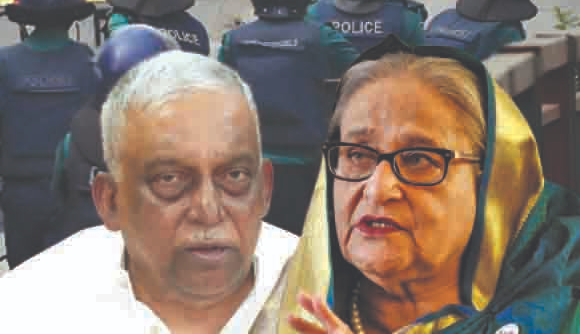
In the incandescent hush that followed a year of convulsive street politics, Bangladesh has reached a juncture that will be read for generations: a national tribunal has rendered the most consequential judgment in the country's contemporary history. What unfolded in Dhaka was not merely a courtroom drama confined to legal technicalities; it was a dramatic, institutional reckoning that seeks to answer a wider question about responsibility at the apex of power. For the victims and their families, for the radicalized youth who galvanized the streets, and for a polity hungry for the restoration of civic dignity, the ruling represents both a legal milestone and a symbolic denouement.
A specially constituted tribunal in Bangladesh — sitting in the capital, Dhaka — has sentenced former Prime Minister Sheikh Hasina to death, concluding a protracted trial that found her culpable in ordering a lethal crackdown against a student-led uprising last year. The International Crimes Tribunal (ICT), which tried Hasina, 78, alongside two other accused figures, delivered the sentence on a Monday that will reverberate across Bangladesh’s political and judicial landscape.
The court, presided over by Judge Golam Mortuza Mozumder, declared that the elements constituting crimes against humanity had been met. In a deliberate and formal reading of the verdict, the judge announced that Hasina was found guilty on three counts — incitement, issuing orders to kill, and failing to prevent atrocities when she was in a position to do so — and that the appropriate sanction, in light of the gravity of the findings, was the death penalty. The tribunal’s determination also encompassed a broader catalogue of alleged actions: authorization of lethal aerial and ground force, targeted murders, and the alleged incineration and concealment of victims’ remains to erase evidence.
The tribunal’s decision did not stand alone. Former Home Minister Asaduzzaman Khan was sentenced to death in absentia after convictions on four counts of crimes against humanity, while Chowdhury Abdullah Al-Mamun, the erstwhile police chief who appeared in court, accepted guilt and received a five-year prison term. The courtroom’s atmosphere — filled, at times, with audible catharsis — mirrored the deep social fissures behind the case: relatives of victims applauded and cried, some outside the tribunal fell to their knees in prayer, and a nation watched a legal process that many regard as a rare moment of accountability for those who wielded the instruments of the state.
Beyond the individual outcomes, the tribunal’s ruling carries multiple legal and symbolic dimensions. On the first charge, Hasina was found guilty of orchestration — the orchestration of mass killings of protesters. The court determined she had engaged in incitement, had issued orders resulting in lethal force, and had failed to enact measures to halt the violence or to punish perpetrators. This set of findings culminated in a sentence of imprisonment until natural death for the first charge. Yet the tribunal’s treatment of the second charge — where the court found that Hasina had ordered the deployment of drones, helicopters and other lethal weaponry against demonstrators — sealed the harsher outcome: capital punishment. For the remaining allegations, although the court pronounced guilt, it refrained from issuing separate penalties because the death sentence under the second charge superseded ancillary sentences.
The tribunal’s punishments also carried the material consequence of property confiscation for both Hasina and Khan. Al-Mamun, whose cooperation provided material evidence for the prosecution and whose guilty plea supplied testimonial weight to the proceedings, received leniency— a relatively short custodial sentence that the court explicitly tied to his cooperation. The tribunal’s mandate extended beyond punitive measures; it directed the state to provide considerable compensation to the families of those killed during the July 2024 movement and to attend to the wounded, although the judgment left unresolved the practical mechanics of identifying the payer for such reparations.
How did the accused respond? From exile in India, Hasina denounced the verdict as politically motivated. She told AFP that the proceedings were orchestrated by an unelected government and presided over by a biased tribunal, asserting her readiness to face accusers in a forum where evidence could be weighed fairly. Her denunciation captures a second narrative: that of a deposed leader contesting the legitimacy of post-revolutionary institutions even as those institutions pursue a retributive or restorative justice agenda.
The background to this seismic trial is no less consequential than the verdict itself. What began on July 1, 2024, as mass demonstrations — primarily driven by students and young people protesting the reinstatement of a High Court policy granting a reserved quota of civil service posts to descendants of 1971 liberation fighters — quickly escalated into a national crisis. By mid-July, the protests had spread across the country, and the state’s response hardened: a telecommunications blackout was imposed and the military was deployed to suppress the unrest. Violent clashes between armed police and students in Dhaka, and attacks attributed to the Awami League’s student wing, the Bangladesh Chhatra League, unfolded amid a landscape of mounting casualties. Independent investigations, including estimates cited by the United Nations, placed the death toll at up to 1,400, with thousands more injured. The tribunal’s inquiry mined that violent tableau for evidence of direction, command, intent and concealment.
The prosecution’s case was buttressed by an extensive evidentiary corpus. The tribunal considered 14 volumes of documentation — approximately 10,000 pages — comprising official reports, medical and postmortem records, ballistics analyses, flight logs and media footage. Ninety-three documentary exhibits and 32 physical artifacts, from ammunition to clothing and field reports, were laid before the court. Over eighty witnesses, spanning survivors, medical professionals, organizers and investigators, testified, with fifty-four giving in-court testimony. The tribunal’s investigative lens also homed in on recorded phone calls allegedly revealing an “open order” from Hasina to “use lethal weapons” and to shoot “wherever they find them,” a line of evidence Al Jazeera reported as part of its own inquiry. These materials, the court held, collectively established the chain of command and the nexus between orders and lethal outcomes.
Procedurally, the tribunal’s route to judgment was methodical, at least in its own framing. The ICT issued arrest warrants in October 2024 for Hasina and dozens of others, ordering Hasina to be produced by November 18. She and other suspects failed to appear, provoking repeated warrants and culminating in formal charges brought on July 10. The trial itself unfolded with testimony heard from August 3 to October 8, followed by closing arguments in mid-October. Security around the tribunal and the surrounding Supreme Court precinct was decidedly tight in the lead-up to the verdict; police, paramilitary units and army contingents were deployed, and authorities imposed shoot-at-sight orders for any pre-verdict unrest involving arson or explosive violence.
Beyond the courtroom, the verdict carries a constellation of political signals. For the interim government that supervised the tribunal, the ruling is an emphatic demonstration that accountability can be pursued after the collapse of an entrenched regime. It serves — for its proponents — as an assertion that even individuals who once occupied the apex of power are not immune to legal scrutiny. For grieving families, the decision is an explicit recognition that their losses mattered in the calculus of justice. For the youth who mobilized in 2024, the judgment is read as a vindication of their moral claims: that abuse of state power and dynastic entrenchment would not go unchallenged.
Yet the verdict also opens a broader debate about the nature of transitional justice, the independence of the judiciary, and the prospects for national reconciliation. Critics, including elements of the former ruling party, have decried the tribunal as a “kangaroo court” — a pejorative frame that casts the process as scripted, partisan and lacking in the due-process hallmarks that distinguish legitimate legal adjudication from political retribution. The tribunal’s composition — led by Judge Golam Murtaza Mazumdar, a retired district court judge whose appointment to the tribunal’s chairmanship drew criticism from the Awami League as irregular — has itself become a focal point in this contest over legal legitimacy.
The significance of this ruling cannot be reduced to a single dimension. On one plane, it is the first major transitional-justice verdict in the post-Hasina era: a legal precedent that asserts the possibility of holding high officials accountable for mass state violence. On another plane, it is a national test of institutional autonomy: whether Bangladesh’s courts can deliver justice free from the partisan pressures that long shaped the country’s political life. And on an emotional plane, for a new generation of voters and activists, the decision is imbued with symbolic force — a sign that the cycle of impunity might finally begin to break.
The practical implications, however, remain complex and unresolved. Questions loom over enforcement: how the sentence will be executed, where the convicted individuals are currently located, and whether international law and diplomatic channels will intersect with domestic proceedings. As the tribunal itself noted, it is unclear how compensation directives will be operationalized — who will ultimately bear the fiscal burden of reparation and how funds will be distributed to the bereaved and injured. The due-process critique raises parallel concerns: whether trials conducted in absentia can satisfy international standards of fairness, and whether the tribunal’s methods will withstand scrutiny should appeals or international legal reviews be pursued.
What is undeniable is that the verdict has altered the political horizon. It signals to various actors — political parties, civil society, the international community and, crucially, the citizenry — that legal instruments are being deployed in the service of accountability. For Bangladesh’s young activists, who view the uprising not simply as a protest against an administrative policy but as the opening act of a larger demand for systemic change, the ruling is not an endpoint but a milestone. They interpret the decision as validating their broader aspiration: an impartial justice system, protection from state intimidation, and genuine electoral democracy unshackled from elite capture.
The tribunal itself was structured as a three-member body. It was chaired by Golam Murtaza Mazumdar and included Mohitul Haque Enam Chowdhury and Shofiul Alam Mahmood. The provenance and composition of the tribunal, however, remain contested in the public square. The Awami League condemned Mazumdar’s appointment, noting that he had retired in 2019 and accusing the interim authorities of elevating him to an appellate-division status for the tribunal’s purposes. Such debates over institutional legitimacy — whether driven by partisan rancor or legitimate procedural concern — are intrinsic to transitional episodes across the world. They shape whether the wider public perceives verdicts as expressions of justice or as instruments of political closure.
The tribunal’s narrative of evidence and testimony was exacting in its scope. The 14 volumes of documentary material, literally tens of thousands of pages, formed the backbone of a prosecutorial effort that sought to trace the lines from command to consequence. Physical exhibits — ammunition, clothing, and other artefacts — and dozens of witnesses provided texture and corroboration to the accounts of survivors and medics. The court’s findings rested on this accumulation: that orders were given, that lethal force was deployed, and that state structures were used to silence dissent in ways that amounted to crimes against humanity.
Yet the legal and political terrain ahead will be contested. Hasina’s characterization of the trial as rigged and politically motivated raises a persistent question for transitional justice advocates: can processes that are initiated by emergent authorities ever secure the political neutrality required to be perceived as legitimate by all segments of society? The tribunal’s defenders answer this by pointing to the depth of the evidence and the procedural steps the court took to receive testimony and examine materials; its critics insist that only an internationally overseen process — or one divorced from immediate political pressures — would satisfy the standards of fairness demanded by international law.
For a nation of 170 million people, the timing of the verdict adds another layer of consequence. The judgment arrived less than three months before the first national election since Hasina’s overthrow and flight to India in August 2024. That proximity amplifies the immediate political stakes: the sentence will shape election narratives, influence mobilization strategies, and test whether emergent institutions can shepherd Bangladesh towards an inclusive and credible democratic transition.
The tribunal’s verdict was also notable for its public presentation. The ruling was broadcast live on national television, transforming a solemn legal pronouncement into a national media event. Such publicization underscores the social resonance of the case: this is not a dispute confined to legal specialists but a public drama that intersects with memory, grief and the contested narratives of a nation’s recent past.
Ultimately, the ruling marks a pivotal moment in Bangladesh’s post-Hasina trajectory. To many citizens who endured loss, it represents a long-sought reckoning: a formal recognition that state violence was not random or accidental but orchestrated and carried out at the behest of political authority. For the polity at large, it raises critical questions about the shape of justice in the wake of authoritarian collapse: how to reconcile demands for accountability with the imperative of fair process, how to translate symbolic justice into institutional reform, and how to ensure that the pursuit of redress does not become a vehicle for successive cycles of retaliation.
If this tribunal marks the beginning of a sincere attempt at transitional justice, the path forward will require more than punitive measures. It will demand institutional capacity to investigate and adjudicate impartially, mechanisms to deliver reparations transparently, and political compromises that permit national healing. In the absence of such a holistic approach, even the most dramatic verdicts risk becoming chapter headings in an ongoing cycle of contestation.
Yet for the survivors and the families whose testimonies formed the backbone of the trial, the verdict is neither purely symbolic nor merely rhetorical. It is a rare form of recognition: that the state — through its courts — has acknowledged their suffering and attached legal culpability to the architects of that suffering. In that sense, the tribunal’s ruling is both a judicial determination and an act of public memory, anchoring last year’s convulsions in a legal narrative that asserts responsibility and seeks to bind a fractured society with the rule of law.
As Bangladesh contemplates the months ahead, the country faces hard choices about enforcement, reconciliation, and the institutional reforms necessary to prevent a repeat of such violence. The tribunal’s decision — historic, contentious and deeply consequential — has set in motion debates that will define the nation’s political and moral contours for years to come. For those who view justice as the bedrock of a democratic polity, the ruling is a moment of hard-won affirmation: a public, judicial attempt to hold power to account and to redefine the relationship between state authority and the citizenry it is meant to serve.