
Impending dangers of small opposition, brute majority

Wahidul Islam
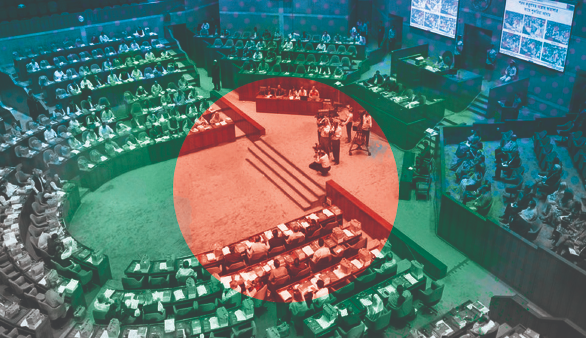
After February 12’s landslide in Bangladesh, small opposition parties risk marginalization, repression, and policy irrelevance; yet coalition-building, institutional resilience, and strategic adaptation can preserve democratic competition and political uncertainty
In majoritarian political systems, small opposition parties often confront structural asymmetries that threaten their survival, relevance, and institutional integrity. When a dominant party commands a brute parliamentary majority, the risks extend beyond electoral defeat to include legal marginalization, resource starvation, repression, and discursive erasure.
On February 12, thirteenth National Parliamentary election, which saw landslide victory for the BNP with 212 seats and Jamaat-led alliance jostled to amass 77 seats, was held peacefully with the lowest number of casualties (9). With two-thirds majority in the parliamentary, BNP has every possibility to disprove the leviathan theory, being very transparent, implementing rule of law and committed to the plethora of promises placed in their either 31-point charter or their manifesto.
But if things proceed traditionally, being carried away by the emotion of total dominance, this situation may invite some dangers. This article will focus on ten possible principal dangers likely to be faced by small opposition parties like Jamaat-led alliance who have less than 100 seats in the Jatiya Sangsad and propose some strategic pathways grounded in comparative political scholarship.
Drawing on theories of competitive authoritarianism, cartel party systems, democratic backsliding and other theories, the study outlines institutional, organizational, and communicative reforms that may enhance resilience.
Robert A Dahl in his book ‘Polyarchy’ wrote democracy presupposes institutionalized contestation. Yet when a ruling party consolidates a commanding legislative majority—particularly in weakly institutionalized systems—competition may persist formally while becoming substantively constrained.
Such a situation is conceptualized by Levitsky as “competitive authoritarian,” where incumbents manipulate institutions to disadvantage opponents without fully abolishing electoral politics. In these contexts, small opposition parties face not merely electoral competition but structural asymmetry.
Brute majority may invite many more dangers including those of ‘tyranny of the majority’.
Institutional Marginalization
A dominant majority can amend parliamentary rules, curtail debate time, weaken committee representation, and bypass opposition oversight (Fish, 2006). Institutional voice diminishes, reducing visibility and policy influence. Such a situation also runs a risk of symbolic participation without substantive power.
Electoral Engineering
Incumbents may redraw constituencies, which is called gerrymandering, alter electoral thresholds, or modify campaign regulations to structurally disadvantage small parties. Pippa Norris in his Why Elections Fail wrote about the risks involved with systemic underrepresentation and vote-seat disproportionality.
Legal and Regulatory Harassment
Administrative probes, burdensome registration requirements, or selective enforcement of laws can be deployed to exhaust opposition resources (Schedler, 2002).
Risk: Organizational paralysis and reputational damage.
Resource Asymmetry
Dominant parties often benefit from state patronage networks, business alliances, and media access (Katz & Mair, 1995). Opposition parties struggle financially and organizationally.
Risk: Inability to mobilize, campaign, or sustain grassroots structures.
Media Exclusion and Narrative Control
State-aligned or captured media may marginalize opposition voices. Digital disinformation campaigns can distort public perception (Tucker et al., 2018).
Risk: Agenda-setting monopoly by the ruling party.
Judicial Capture
If courts lack independence, opposition appeals against electoral irregularities or executive overreach may fail (Ginsburg & Huq, 2018).
Risk: Closure of institutional redress mechanisms.
Co-optation and Defection
Dominant parties may entice opposition leaders with patronage or positions, fragmenting party cohesion (Greene, 2007).
Risk: Internal fragmentation and loss of credibility.
Repression and Intimidation
Opposition activism may be curtailed through surveillance, arrests, or restrictions on assembly (Levitsky & Way, 2010).
Risk: Demobilization of supporters.
Public Perception of Inevitability
Voters may internalize the dominance of the ruling party as inevitable, creating a bandwagon effect
(Przeworski, 1991).
Risk: Strategic voting away from small parties.
Policy Irrelevance
With limited legislative leverage, small parties’ risk being perceived as ineffective protest platforms rather than governing alternatives.
Risk: Long-term erosion of political legitimacy.
Strategic Pathways Forward
Despite structural disadvantages, comparative experience suggests viable adaptive strategies.
1. Coalition Building and Pre-electoral Alliances
Opposition fragmentation benefits dominant incumbents. Strategic alliances—especially under first-past-the-post systems—can mitigate vote splitting (Cox, 1997). Ideological flexibility may be necessary to achieve electoral viability.
2. Institutional Litigation and Rule-of-Law Advocacy
Even partially independent courts or international forums can constrain executive overreach. Strategic litigation keeps constitutional issues in public debate (Ginsburg & Huq, 2018).
3. Grassroots Deepening
When national arenas are constrained, local governance platforms can serve as laboratories of credibility. Subnational success builds administrative reputation and organizational capacity.
4. Programmatic Differentiation
Opposition parties must articulate coherent policy alternatives rather than relying solely on anti-incumbent rhetoric. Programmatic clarity enhances voter trust (Kitschelt, 2000).
5. Digital Communication Strategies
In constrained media environments, social media offers partial bypass mechanisms. However, credibility and fact-based communication are essential to counter misinformation (Tucker et al., 2018).
6. Internal Institutionalization
Strong internal democracy reduces vulnerability to co-optation and defection. Transparent candidate selection and leadership renewal enhance resilience (Panebianco, 1988).
7. Financial Transparency and Small-Donor Models
Reducing reliance on large donors mitigates vulnerability to economic pressure. Crowdfunding models have strengthened opposition resilience in several contexts.
8. Civic and Civil Society Linkages
Alliances with labor unions, professional associations, and social movements broaden legitimacy and resource bases. Such horizontal networks reduce isolation.
9. Normative Framing: Defender of Institutions
Rather than positioning as mere power-seekers, small parties may frame themselves as guardians of constitutionalism and democratic norms (Bermeo, 2016). Norm-based appeals can mobilize cross-partisan constituencies.
10. Long-term Cadre Development
Sustainable opposition requires investment in youth leadership, policy research units, and think tanks. Organizational depth matters more than episodic mobilization.
Discussion
The structural asymmetry between a brute majority and a small opposition is not merely electoral but systemic. However, dominance does not equal permanence. As Przeworski (1991) argues, democratic uncertainty is inherent; dominant parties often appear invincible until sudden realignments occur.
Opposition survival depends on strategic patience, organizational professionalism, and adaptive learning. Comparative cases—from Mexico’s PRI era to contemporary hybrid regimes—demonstrate that entrenched dominance can erode under sustained opposition coordination and civil resistance (Greene, 2007; Levitsky & Way, 2010).
At the end, small opposition parties confronting brute majorities face a constellation of structural dangers: institutional marginalization, electoral manipulation, repression, and discursive erasure. Yet survival and eventual competitiveness remain possible through coalition-building, grassroots strengthening, internal institutionalization, and normative framing.
The resilience of democracy ultimately depends not only on electoral outcomes but on the persistence of organized alternatives. Opposition parties, even when numerically weak, constitute the latent guardians of democratic uncertainty.