
Islam, Identity, and Politics in Post-Uprising Bangladesh

Md Tareq Hasan
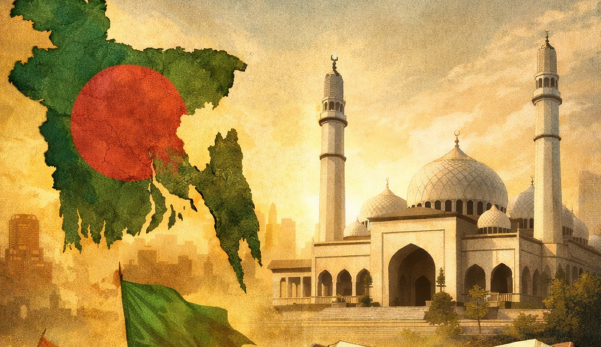
In post-uprising Bangladesh, tensions between Islamic identity and secular intellectual hegemony are redefining political legitimacy, as advocates call for institutional reform, ethical governance, and a civic framework that integrates religious agency with democratic accountability and national sovereignty
Bangladesh today stands at a crucial juncture where historical grievances, religious identity, and political legitimacy intersect in ways that demand rigorous analytical scrutiny. The contemporary political crisis in Bangladesh cannot be understood without acknowledging the historical marginalization of Islam as a political and social force. Since the country’s independence, the role of Islam in shaping civic identity, social consciousness, and political agency has been systematically undermined, not because the population is irreligious, but because of deliberate cultural and ideological hegemonies imposed by the ruling elite and secular intellectual class.
Islam in the Indian subcontinent has always evolved organically, deeply embedded in the social, moral, and ethical fabrics of communities. Even where religious practices are unevenly observed, Islam functions as a guiding framework for values, ethics, and social norms. The secularization campaigns spearheaded by certain intellectual circles, often aligned with the state machinery, have sought to diminish this organic influence under the guise of modernism and progressivism. Yet, this deliberate Islamophobia has inadvertently intensified political tensions, social unrest, and institutionalized injustice by eroding the legitimacy of indigenous political and ethical structures. In this sense, the marginalization of Islamic values is not merely a religious question, it is a structural and political strategy that has deep implications for governance and social cohesion.
The Political and Ethical Framework of Islam
In Muslim-majority societies, Islam is not just a religious faith; it is the primary source of ethical orientation and political imagination. The notion of Ummah in Islam is not symbolic; it is a potent political and cultural construct that binds communities across borders and informs collective aspirations. The legal and moral prescriptions of Halal and Haram operate as ongoing ethical calibrations, shaping individual and societal choices. Islamic Sharia serves as both a moral compass and a framework for political projects, emphasizing justice, welfare, and the centrality of monotheism. The authority of Allah is absolute in Islam, and this authority cannot be partially accepted. Consequently, political actors who operate within an Islamic framework inherently recognize divine guidance as the ultimate arbiter of justice, rendering secular reinterpretations of Islam inadequate for capturing the full spectrum of political legitimacy in Muslim-majority societies.
This framework explains why Islamist political parties in Bangladesh, despite strategic differences among themselves, consistently anchor their political agendas in the authority of Allah. Secular ideologies have no theological foothold in such a framework. Attempts by secular intellectuals to reinterpret Islam through a modernist lens, or to diminish its political relevance, are not neutral academic exercises, they are acts of political subversion that undermine social cohesion. In essence, the political significance of Islam is inseparable from the civic identity of the majority population, and any national discourse that neglects this fact risks structural instability.
Global Islamic Consciousness and Local Political Realities
Islam is simultaneously a local and global phenomenon. Islamist movements, scholars, and parties, though operating independently, are interconnected through shared religious and political consciousness. Events like the Gaza massacres and other global crises have strengthened transnational solidarities, providing local populations with frameworks of political and ethical interpretation derived from broader Islamic scholarship. This transnational influence reinforces the political role of Islam in Bangladesh and other Muslim-majority countries, shaping public perceptions and mobilizing political agency.
The consequences of ignoring this global-local nexus are evident. When secular intellectuals in Bangladesh attempt to sideline Islamic political agency under the banner of human rights violations in 1971, they fail to address the larger reality: the political rights of Muslims cannot be negated by historical grievances, however significant. While historical justice remains a legitimate concern, it cannot serve as a pretext for suppressing the religious and political agency of the present. Human rights violations must be resolved transparently and judicially; politicizing them as a tool to invalidate the Islamic political identity of citizens perpetuates structural injustice.
Islam and Civic Identity
In Muslim-majority countries, language and ethnicity may define civic components, but they cannot fully constitute identity. A complete and coherent civic identity requires a moral and ideological anchor, and for Muslims, Islam provides this anchor. Neglecting this fundamental truth in constructing political discourse or national identity invites instability and cultural alienation. Political actors and policymakers in Bangladesh must acknowledge that civic identity cannot be divorced from Islamic moral frameworks without creating systemic dissonance between the people and the state.
The historical roots of Bangladesh’s contemporary political crisis lie precisely in this dissonance. Post-independence elites, including secular intellectuals and political leaders, have consistently attempted to subordinate Muslim identity to a hegemonic cultural narrative, marginalizing Islamic principles and values in governance, public policy, and social discourse. The result has been an artificially fragmented political culture, where the majority population’s religious identity is sidelined while the state consolidates power through personality cults and selective historical narratives.
Towards a Cultural and Political Consensus
Resolving Bangladesh’s political crisis requires a deliberate reorientation of national consciousness. Cultural hegemony must be countered with a broad-based national consensus that recognizes Muslim identity as a core element of the majority’s political and civic identity. Such a consensus should not be symbolic; it must be operationalized through policy frameworks, institutional reforms, and political alliances that respect ethical governance and the authority of Islam in public life.
Beyond identity recognition, fundamental commitments are essential for sustainable governance. Political stability and legitimacy demand good governance, zero tolerance for corruption, strong institutions over personality-driven politics, and foreign and security policies aligned with national interests rather than external agendas. These principles must inform alliances among political actors who share a commitment to justice, transparency, and national sovereignty. Moreover, the aspirations articulated during the July 2024 Revolution, such as “Azadi na Golami” (Freedom, not Subjugation) must guide the reconstruction of political culture. These slogans are not mere rhetoric; they encapsulate the desire for an independent, sovereign, and just state, free from external manipulation or internal despotism.
Secular Intellectualism and Structural Islamophobia
A critical obstacle to this transformation is the entrenched secular intellectual class, which has monopolized societal institutions and imposed ideological gatekeeping. Terms such as “progressive” and “non-communal” are deployed not as analytical categories but as instruments of exclusion, framing Islam and Islamic political actors as inherently regressive or intolerant. This ideological construction fosters a culture of sanctioned Muslim hatred, while simultaneously presenting the intellectual elite as neutral arbiters of morality and modernity.
This bias manifests institutionally. Even at Dhaka University—founded on the sacrifices of major Muslim citizens—the ability to hold academic seminars or discussions on Islam is severely restricted. Although some progress has been achieved post-August 2024, structural discrimination persists, legitimized by selective historical narratives surrounding the 1971 Liberation War. The secular intellectual class strategically maintains this monopoly, using historical grievance to justify contemporary exclusion, while international Islamophobic networks reinforce these strategies. Media, NGOs, and civil society organizations with global funding channels contribute to constructing a socially pervasive Islamophobic ecosystem, normalizing discrimination and hindering reform.
Political Implications and the Road Ahead
The post-August 2024 environment in Bangladesh presents both opportunity and risk. Efforts toward reform, good governance, and institutional accountability face systemic resistance from entrenched elites who seek to perpetuate personality-driven politics and inhibit the rise of value-driven political actors. In such a context, political competition among actors committed to justice, ethical governance, and Islamic-informed civic identity is not merely desirable, it is essential for societal sophistication, accountability, and stability.
Bangladesh’s future hinges on the capacity of political actors to synthesize historical consciousness, religious identity, and reformist governance. National cohesion demands a cultural consensus recognizing the centrality of Islam in civic identity, combined with institutional reforms that enforce accountability, ethical governance, and strategic independence. Without this dual approach, cultural legitimacy coupled with institutional rigor, political instability and societal dissonance are inevitable.
Bangladesh’s political landscape reveals the complex interplay between religion, identity, and governance. Islam, as both a moral and political framework, remains indispensable in shaping civic identity and political legitimacy. Secular intellectual hegemony, structural Islamophobia, and personality-driven politics have undermined these foundations, exacerbating societal tensions and institutional inefficiency. The July 2024 Revolution offers a historical inflection point: a moment to realign political discourse with the ethical, cultural, and moral realities of the majority population.
Moving forward, the challenge for Bangladesh is not merely to reconcile past grievances, but to construct a political and cultural order that acknowledges the authority of Allah in public life, institutionalizes justice, and respects the political agency of its Muslim-majority citizenry. Only through such a synthesis can the nation achieve genuine sovereignty, social justice, and durable political stability.
In essence, ignoring Islam as a core element of national identity is not an academic omission; it is a structural miscalculation with profound political and social consequences. Any attempt to marginalize Islamic identity under the pretext of progressivism, human rights, or secular modernity will inevitably produce conflict, destabilize civic identity, and perpetuate political illegitimacy. Bangladesh’s path forward must be guided by a realistic acknowledgment of these truths, forging a political culture rooted in justice, morality, and the lived realities of its people.
This is the first part of a two-part analysis. The last part will be published in the April 2026 issue.