
Trump’s Elusive Quest for Peace in Ukraine: Fractures, Fatigue, and the Fog of Grand Strategy

Shaheen Reza and Iqbal Ahmed
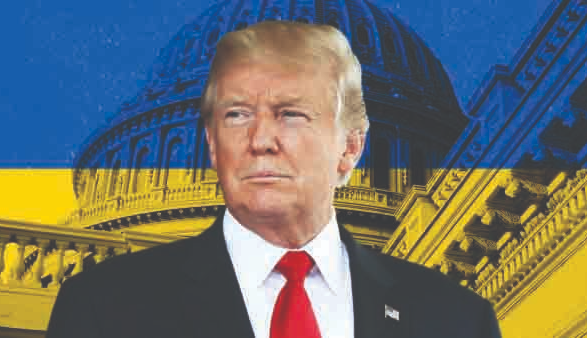
Nearly five months into his second tenure, President Donald Trump finds himself no closer to delivering a diplomatic breakthrough in Ukraine than he was upon reassuming office. Despite having made the promise of swift and decisive peace a pillar of his 2024 campaign, the complex realities of global power politics have proven resistant to the certainties of political slogans. As war continues to rage in Eastern Europe, the Trump administration’s approach appears muddled, reactive, and fragmented — a far cry from the confident rhetoric that once animated his vision of “peace through strength.”
During the 2024 election, Trump was unrelenting in his critique of President Joe Biden’s handling of the war. He confidently asserted that had he been at the helm, Russia’s invasion of Ukraine would never have transpired in the first place. It was a central tenet of his foreign policy pitch to the American electorate: only he, a self-styled master negotiator, could bring the warring parties to the table and achieve a resolution where previous administrations had failed. Though foreign policy was not the foremost issue on voters' minds, Trump’s persistent framing of the Ukraine war as a consequence of weak leadership resonated with his base.
Upon returning to the White House, however, Trump was met not with the pliable pieces of a deal waiting to be assembled, but with a geopolitical puzzle of staggering complexity. His early pledge to secure peace in 24 hours — a bold, headline-grabbing promise — has since vanished from official discourse. In its place lies silence, or vague assurances that progress is being made behind closed doors.
The stagnation can be attributed, in part, to the administration’s overextended and disjointed foreign policy agenda. Instead of channeling sustained energy toward resolving the Ukraine conflict, the Trump administration has attempted to juggle a multitude of international flashpoints simultaneously. From renegotiating global trade agreements and managing a worsening US-China rivalry in the Indo-Pacific, to navigating the fallout of Israel’s strikes on Iran and reopening nuclear negotiations with Tehran, the White House has diffused its strategic focus. This shotgun approach to diplomacy has weakened the administration’s capacity to generate momentum on any single front — Ukraine chief among them.
Compounding this strategic dilution is a persistent lack of internal coordination within the US government. Mixed signals, erratic policy decisions, and bureaucratic inconsistency have plagued the administration’s Ukraine strategy. Assistance to Kyiv — both military and financial — has been sporadic. At various junctures, the Pentagon and intelligence community have scaled back support, only to be pressured back into action by bipartisan coalitions in Congress. Republican lawmakers who continue to view Ukraine as a frontline defense against authoritarian expansion have been instrumental in keeping aid alive. Yet this support is not guaranteed to last.
Current projections suggest that US funding for Ukraine will begin to dry up by late summer. Yet the administration has not articulated a coherent plan for what follows. This strategic ambiguity is not lost on the Kremlin. Moscow, sensing an opportunity, appears to be deliberately dragging out diplomatic overtures, confident that Western resolve — particularly in Washington — is softening.
Even more troubling than the administrative stumbles is the apparent asymmetry in diplomatic pressure. Since Trump’s return to office, Washington has leaned heavily on Kyiv, pressuring Ukraine to show “flexibility” in negotiations. Ukraine, despite its dire circumstances, has complied with nearly every US condition. Moscow, on the other hand, has faced relatively little sustained pressure to engage in talks on equitable terms. Such an imbalanced approach is not only unjust — it is strategically short-sighted. Without holding Russia to account, any proposed peace will rest on an unstable foundation.
Yet perhaps the most significant obstacle to coherent policy lies within the Republican Party itself. Trump’s GOP is a house divided when it comes to America’s global role, and these ideological rifts are bleeding into the administration’s foreign posture. The old consensus — one built on post-Cold War ideals of American leadership and alliance-building — has fractured.
One wing of the party, though increasingly marginalized, consists of traditional conservatives who believe in robust American engagement abroad. These Reagan-era stalwarts argue that sustained support for Ukraine is not mere altruism; it is a strategic necessity that weakens one of Washington’s foremost adversaries. However, their voices are being drowned out by a more vocal coalition of skeptics and critics.
The dominant voices now fall into three camps. First are the isolationists — conservatives who view involvement in Ukraine as an expensive entanglement that yields little benefit to American citizens. They argue that US treasure and blood should not be spent defending borders in Europe while domestic priorities remain underfunded. For them, disengagement is not just practical — it’s philosophical. Then there are the “prioritizers,” a camp that doesn’t necessarily oppose foreign engagement but believes America must triage its commitments. They argue that the existential challenge posed by a rising China demands a redirection of all US diplomatic and military energy toward Asia. According to this view, commitments in Europe or the Middle East are distractions that weaken America’s strategic hand against Beijing.
Finally, an emerging fringe group within the Republican coalition has begun to argue that Russia, rather than being treated as an adversary, should be cultivated as a strategic counterbalance to China. They propose a detente between Washington and Moscow, a revival of Nixonian triangulation — but in reverse. This logic, dangerously naive and historically blind, disregards Russia’s long record of aggression, subversion, and its own ambitions to dismantle the post-Cold War international order.
This ideological dissonance within Trump’s political base has paralyzed meaningful strategic planning. Allies in Europe and beyond, long accustomed to the steady hand of American leadership, now face confusion and anxiety. Washington’s fractured messaging and shifting priorities have undermined US credibility, complicating efforts to build and sustain multilateral coalitions. In the absence of internal coherence, America’s diplomatic influence risks erosion.
So where does this leave Trump? There is little doubt that he remains personally invested in brokering a peace deal. Beyond the humanitarian imperative, he sees the Ukraine conflict as an opportunity to cement his legacy as a peacemaker who succeeded where his predecessors failed. But aspiration alone is insufficient.
If the Trump administration hopes to forge a viable path to peace, it must pivot toward concrete, actionable strategies. First and foremost, the White House should collaborate with Congress to craft and pass a rigorous sanctions package aimed squarely at Moscow — one that would trigger automatically if the Kremlin fails to negotiate in good faith. Such a measure would not only increase leverage at the negotiating table but also reassert American resolve.
Secondly, contingency planning is urgent. With funding for Ukraine expected to run dry in a matter of months, the administration must formulate a plan for continued aid. One potential avenue lies in leveraging the recently signed US-Ukraine critical minerals agreement. By tying military assistance to economic partnerships, the administration could ease domestic concerns about cost while securing long-term strategic returns.
Trump must also recalibrate his diplomatic approach. Rather than treating Ukraine as a unilateral American project, he should engage regional stakeholders who possess both influence and interest. Saudi Arabia and Turkey, both of which have hosted past negotiations, could serve as useful intermediaries in future talks. Coordinated efforts with such partners could increase legitimacy and improve chances of breakthrough.
Ultimately, while the path to peace remains shrouded in uncertainty, one truth is increasingly clear: diplomacy, if pursued with discipline, creativity, and resolve, still holds the key. The stakes are enormous — not only for Ukraine, but for the entire transatlantic order. Should Trump rise to the occasion, he could reshape his presidential legacy, reinforce America’s role as a global leader, and bring the world closer to ending one of the deadliest conflicts of the 21st century. But failure to act decisively could just as easily define his tenure as a missed opportunity — one where bold promises collapsed under the weight of political entropy.