
Who is next after Iran?

Md Abdur Rahman
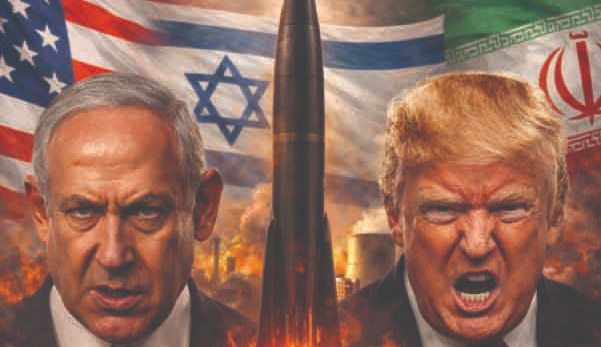
For more than a generation, one Israeli leader has spoken as if history were moving toward a single inevitable collision. That leader is Benjamin Netanyahu. Through speeches before the U.S. Congress, warnings delivered at the United Nations, and constant lobbying inside Washington’s political system, he has framed Iran not merely as a rival state but as the central strategic problem of the Middle East.
For Netanyahu, Iran was never simply a challenge to manage; it was a confrontation waiting to happen. Today, that confrontation has arrived. And it has not arrived in the limited form often imagined in Western policy circles, a symbolic strike, a contained escalation, or a diplomatic crisis wrapped in military signaling. Instead, the world now faces the possibility of a full-scale strategic confrontation between Iran and a coalition whose core military power lies in the United States.
The consequences of such a conflict would extend far beyond the battlefield. What is unfolding is not another Middle Eastern war.
It represents a deeper structural crisis: the collision between a long-standing Israeli project to reshape regional power dynamics and an American strategic system increasingly willing to enforce that vision with overwhelming force. Whether this gamble stabilizes the region or accelerates a broader geopolitical unraveling remains one of the defining questions of our time.
The War Netanyahu Spent Decades Preparing
Few modern political figures have built their careers around a single strategic argument as relentlessly as Netanyahu has around Iran.
Since the early 1990s, he has insisted that Iran represents an existential threat not only to Israel but to the entire Western order. The message has been repeated so frequently that it has become part of the background noise of international politics. But repetition does not erase the ideological dimension embedded in the argument.
For years, influential figures within Israeli political and strategic circles have spoken openly about a broader project: the transformation of the Middle East into a geopolitical landscape more compatible with Israeli strategic dominance. The language used in these discussions sometimes echoes the idea of a “Greater Israel,” a concept that imagines the region not as a collection of sovereign states with fixed borders but as a strategic environment to be reorganized.
In that worldview, the Middle East is not a stable system. It is a chessboard. States, alliances, and political movements are treated as pieces to be repositioned until a new regional order emerges. That means one that eliminates hostile actors and permanently secures Israel’s supremacy.
The rhetoric surrounding Iran has therefore never been solely about nuclear weapons or missile capabilities. Those concerns exist, but they are nested inside a broader ideological framework: the belief that Israel must reshape its strategic environment before its adversaries can reshape it.
Netanyahu has long believed that history could be pushed in that direction. Now, with American military power standing behind Israel’s strategic calculations, he appears to believe the moment for that push has finally arrived.
The Familiar Justification for War
Official explanations for the current confrontation follow a script that has become deeply familiar in American foreign policy. Senior officials in Washington including figures such as Pete Hegseth and Marco Rubio present the conflict as a matter of urgent necessity. According to their narrative, Iran is approaching a dangerous threshold in its nuclear program, its missile capabilities threaten regional stability, and American security requires decisive action.
The logic is straightforward: Iran must be stopped before it becomes unstoppable. But history casts a long shadow over such claims. Two decades ago, the administration of George W. Bush justified the invasion of Iraq with similar certainty. British Prime Minister Tony Blair echoed those warnings, insisting that the regime of Saddam Hussein possessed weapons of mass destruction that posed an imminent threat to global security. The world now knows how that story ended.
The invasion of Iraq destroyed the Iraqi state, destabilized the region, and unleashed waves of violence that cost hundreds of thousands of lives. Yet the central claim that justified the war and the existence of active WMD programs proved unfounded. That experience fundamentally damaged Western credibility.
It also revealed something deeper: the tendency of powerful states to construct narratives of imminent threat in order to justify wars that are, in reality, driven by broader strategic ambitions. Today’s rhetoric about Iran bears an unsettling resemblance to that earlier moment.
Diplomacy as Political Theatre
What makes the current crisis particularly striking is the timing. In the months leading up to the confrontation, diplomatic channels appeared to be opening. Negotiations between Iran and Western powers took place in venues such as Oman and Switzerland, where diplomats explored possibilities for limiting uranium enrichment and expanding international oversight.
Tehran signaled a willingness to compromise. Observers familiar with the talks noted that the Iranian government appeared prepared to accept stricter monitoring and potentially reduce the scale of its enrichment activities. These proposals did not resolve every concern, but they suggested that de-escalation remained possible. Yet while diplomats spoke of compromise, military preparations quietly accelerated. Naval deployments increased across the Indian Ocean and the Persian Gulf. Strategic bombers were repositioned. Carrier groups moved closer to Iranian waters.
In retrospect, the diplomatic process now appears less like a genuine attempt at resolution and more like a familiar ritual in international politics: negotiations conducted while military options are prepared behind the scenes.
The result was a sudden shift from dialogue to confrontation. Strikes targeted Iranian territory. Political and military figures were killed. Cities experienced the shock of bombardment. And yet, in much of the Western narrative, Iran was immediately framed as the primary aggressor.
The Mythology of Israeli Military Invincibility
To understand the psychology behind this confrontation, it is necessary to examine one of the most powerful myths in modern Middle Eastern politics: the belief in Israel’s overwhelming military superiority. This narrative emerged from a series of wars that shaped regional history, particularly the conflicts of 1948, 1967, and 1973. But the mythology often obscures the complexity of those events.
1948: A Fragmented Arab Response
The war that followed the establishment of the state of Israel is frequently portrayed as a heroic victory against a unified Arab coalition. According to the popular narrative, Israel faced a coordinated invasion by multiple Arab states determined to destroy it.
The reality was far more complicated. In 1948, much of the Arab world was still emerging from colonial domination. Many armies lacked coherent command structures or modern equipment. Political rivalries between Arab governments undermined attempts at coordination. The most capable Arab force on the battlefield, the Arab Legion of Transjordan was commanded not by an Arab officer but by the British general John Bagot Glubb. Jordan’s King Abdullah pursued his own territorial ambitions, focusing on control of the West Bank rather than a broader strategy to defend Palestine.
Meanwhile, Egyptian forces entered the war under the troubled rule of King Farouk, whose military leadership struggled with corruption and poor preparation. The infamous scandal involving defective weapons later exposed the extent of dysfunction within the Egyptian command. Palestinian fighters themselves were largely abandoned.
One of their most prominent commanders, Abd al-Qadir al-Husayni, repeatedly appealed to the Arab League for weapons and reinforcements. His pleas went largely unanswered. He was killed in battle near Jerusalem after leading his men into combat with dwindling ammunition.
What unfolded in 1948 was not a unified Arab war effort but a fragmented struggle shaped by competing interests and colonial legacies. Israel’s victory owed as much to organizational cohesion and international backing as it did to battlefield prowess.
The Strategic Shock of 1967
The Six-Day War reinforced Israel’s reputation for military brilliance. In reality, the decisive factor in that conflict was a preemptive Israeli air strike that destroyed Egypt’s air force on the ground within hours of the war’s opening. Once Israel achieved complete control of the skies, the outcome became almost inevitable.
This was not a prolonged contest between evenly matched forces. It was a strategic ambush that crippled Arab militaries before they could fully mobilize. The war transformed Israel’s regional position, but it also reinforced a dangerous belief: that military superiority could guarantee long-term strategic dominance.
1973: The Moment the Myth Cracked
The Yom Kippur War challenged that assumption. Egyptian forces under Anwar Sadat launched a surprise offensive across the Suez Canal, breaching Israel’s heavily fortified Bar Lev Line. For the first time since Israel’s founding, an Arab army demonstrated the capacity to plan and execute a sophisticated large-scale operation. The initial success stunned Israeli commanders and shook the aura of invincibility created in 1967.
Yet the war ultimately evolved into a diplomatic turning point rather than a strategic transformation. A massive American airlift replenished Israeli losses and restored its military balance. Sadat then shifted toward negotiations, culminating in the Camp David Accords.
The episode revealed that Israeli military dominance was not absolute, it was contingent on continued American support.
Wars Against Non-State Actors
In the decades that followed, Israel’s most significant conflicts were not against powerful states but against non-state movements. In Lebanon, the Israeli army confronted Hezbollah and eventually withdrew after years of attritional warfare.
In Gaza, Israel has repeatedly fought Hamas, employing overwhelming airpower and siege tactics. Yet despite devastating military campaigns, neither Hezbollah nor Hamas has been eliminated. Hostages captured during these conflicts were often returned through negotiations rather than battlefield victories.
These wars demonstrate the limits of overwhelming force against decentralized opponents. But they also mean that Israel has not fought a prolonged conventional war against a large, organized state in decades.
The American Pattern of War
The American Pattern of War
The United States shares a similar strategic pattern. Since the end of the Cold War, American military campaigns have largely targeted weakened states. The 2003 invasion of Iraq occurred after years of sanctions had devastated the country’s economy and degraded its military. Afghanistan involved counterinsurgency against decentralized power networks.
Operations in Libya, Somalia, and Syria took place within fractured political landscapes where no single opponent possessed the capacity to challenge American power directly. These conflicts created a sense of military comfort. Washington became accustomed to wars in which technological superiority and overwhelming firepower quickly tilted the balance. Iran presents a fundamentally different challenge.
Iran: A Different Kind of Adversary
Iran is neither a collapsed state nor an insurgent movement. It is a large nation with deep historical roots, a population approaching ninety million, and a political system that has survived decades of economic sanctions and international isolation. Since the Iranian Revolution overthrew the Western-backed monarchy of Mohammad Reza Pahlavi, the Iranian state has built a military structure designed specifically to resist external pressure.
Its missile arsenal is among the largest in the Middle East. Its drone program has expanded rapidly. Domestic weapons industries now produce a wide range of systems once imported from abroad. Iran also benefits from geographic depth, a strategic factor often overlooked in Western planning. Its mountainous terrain and vast territory complicate any attempt at sustained military operations.
Perhaps most importantly, the Iranian political system has developed mechanisms of resilience. Leadership transitions occur within a stable institutional framework centered around figures such as Ali Khamenei. This structure allows the state to absorb shocks while maintaining continuity. Dismissing Iran’s leadership as irrational or fanatical therefore risks misunderstanding the nature of the adversary.
The Ideological Blind Spot
Public rhetoric from American officials often reflects that misunderstanding. At press briefings and political events, Iranian leaders are frequently described as extremists driven by apocalyptic ideology. Such portrayals simplify a complex political system into caricature.
Yet the irony is difficult to ignore.
The American political coalition supporting this confrontation includes strong currents of Christian Zionism which is a movement that interprets Middle Eastern politics through biblical prophecy. Figures such as former U.S. ambassador Mike Huckabee have openly invoked religious narratives when discussing Israeli territorial claims.
The presence of religious ideology on both sides of the conflict raises an uncomfortable question: whose worldview is truly shaping the strategic decisions now being made?
Iran’s Strategic Logic
Iran’s response to the confrontation reveals a clear strategic understanding of its position. Tehran does not view Israel as an isolated opponent. Instead, it sees Israel as the most fortified outpost within a broader American security architecture spanning the Middle East. This architecture includes U.S. bases and logistical hubs in Bahrain, Kuwait, the United Arab Emirates, Iraq, and other regional states.
Iranian strategy therefore targets the system rather than a single node. Missile strikes and drone operations have focused on energy infrastructure, shipping lanes, and military installations connected to the American network. The objective is not simply retaliation. It is to raise the strategic cost of war to a level that threatens the economic foundations of American global influence.
The Persian Gulf remains one of the most important arteries of the world economy. Disruptions to energy flows could ripple through currency markets, supply chains, and financial systems. The petro-dollar, the mechanism through which global oil trade reinforces the dominance of the U.S. dollar depends on stability in precisely the region now facing escalation. Iran’s strategy seeks to exploit that vulnerability.
The Risk of Imperial Overreach
For Washington, the confrontation carries profound risks. Great powers often make their most consequential mistakes when they become convinced of their own invincibility. Military strength can create an illusion of unlimited strategic flexibility. Leaders begin to believe that force can solve political problems and that adversaries will inevitably yield.
History repeatedly demonstrates the dangers of such assumptions. The British Empire confronted a similar moment in 1956 during the Suez Crisis. Convinced that its global authority remained intact, Britain joined France and Israel in a military operation to regain control of the Suez Canal after Egypt nationalized it.
The campaign initially appeared successful. But financial pressure from the United States and diplomatic opposition from the broader international community forced Britain to withdraw. The episode exposed a painful truth: Britain still possessed formidable military capabilities, but it no longer possessed the political legitimacy or economic independence necessary to wield them effectively. The Suez Crisis marked the beginning of the end of Britain’s imperial era.
Could Iran Become America’s Suez?
The parallels are not exact, but the strategic logic is hauntingly similar. A powerful state, convinced of its superiority, launches a military intervention designed to reshape a regional order. The operation is justified through claims of security and stability. Yet the deeper objective is the preservation of geopolitical dominance.
If the confrontation with Iran expands into a prolonged conflict, especially one that disrupts global energy markets and fractures international alliances, it could expose the limits of American power in ways that echo Britain’s experience in 1956. Empires rarely collapse suddenly. More often, they begin to decline when a single crisis reveals that their power is less absolute than they imagined.
The Hubris of Power
The greatest danger facing Washington today may not be Iranian missiles or regional instability. It may be hubris. Empires at the height of their power often begin to believe their own myths. They interpret past victories as proof of permanent superiority.
They convince themselves that military force can bend history to their will. But history has a way of punishing such confidence. From Vietnam to Iraq, the United States has repeatedly discovered that overwhelming military capability does not guarantee political success. The confrontation with Iran may prove to be the most consequential test of that lesson yet. If Washington miscalculates, if it underestimates the resilience of the Iranian state or the economic shockwaves of a prolonged war, the outcome could reshape not only the Middle East but the global balance of power.
A Moment of Strategic Reckoning
The war now unfolding did not emerge suddenly. It is the culmination of decades of strategic argument, ideological conviction, and geopolitical maneuvering. For Netanyahu, it represents the realization of a long-held belief that Iran must eventually be confronted.
For Washington, it represents a gamble. One that assumes American military power can still dictate the trajectory of Middle Eastern politics. But wars driven by ambition rather than necessity rarely unfold according to plan. And if the past century of global politics offers any lesson, it is this: the greatest powers often discover their limits not in moments of weakness, but in moments of supreme confidence.
If that pattern holds, the confrontation with Iran may ultimately be remembered not as the beginning of a new Middle East shaped by American and Israeli strategy. It may instead mark the moment when the limits of that strategy finally became impossible to ignore and the reality is very simple that this world is edging closer to the destruction under Trump and Netanyahu where they are doing everything whatever they want.